


When the hip joint hurts, the most exciting questions are what to do and how to treat the disease.The hip joint is one of the most significant and stressed joints in the entire musculoskeletal system.Loss of mobility due to pain can partially or completely deprive a person of the ability to move.The answer to the question of how to treat pain is simple - to identify and eliminate its cause.
Possible causes of hip pain
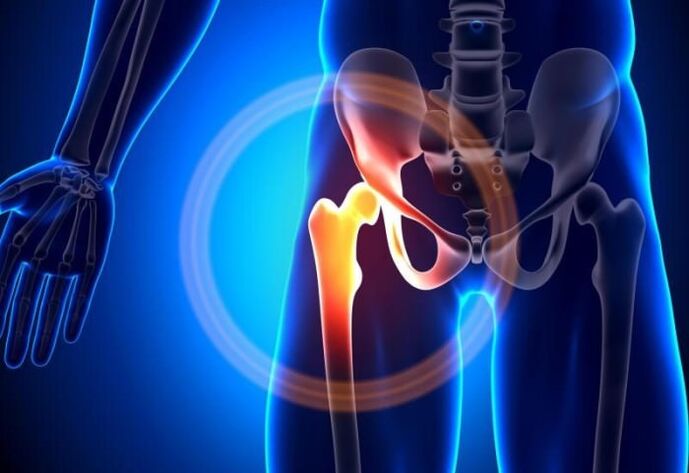
First of all, it is necessary to pay attention to when pain occurs in the hip joints.This can happen at the following points:
- during the morning rise;
- during physical activity, while running;
- during normal walking;
- in a motionless state.
It is worth listening to your body and trying to recognize the systemic nature of the pain.
Important!In diseases of the hip joint, due to the structural characteristics of the nerve bundles, the pain can also radiate to the leg.This reaches the extent that the patient thinks that his leg or knee hurts until the last moment, and does not even suspect that the source of the pain is in the hip.
The nature of hip pain can also vary.The following types of hip pain occur:
- sore;
- intermittent acute;
- suddenly acute.
The main causes of pain in the hip joint must be precisely determined.
Trauma
It is most often preceded by a fall or a sharp jump from a height.Signs of injury include:
- sharp pain;
- edema;
- restriction of movement;
- visual deformation;
- inability to rotate the foot outward.
The injury is dislocation, fracture or contusion.
Coxarthrosis
This is arthrosis of the hip joint, a degenerative change in the cartilage and bone tissue.The symptoms of coxarthrosis are as follows:
- crunch;
- stiffness in movements;
- painful and intermittent sharp pain;
- increased pain in bad weather and at night;
- deformation;
- swelling.
It is most often encountered by older people.
Bursitis of the trochanteric bursa
The trochanteric bursa or bursa contains synovial fluid and its inflammation is called bursitis.The source of the pain is often felt in the buttocks.The pain increases when you lie on the injured joint.Exacerbations occur at night.
Systemic lupus erythematosus
It is an autoimmune disease.Your own cells are attacked by the immune system, which causes inflammation in the muscles and joints.Symptoms of lupus erythematosus include:
- high temperature;
- blisters, ulcers on the mucous membrane and skin;
- muscle weakness;
- pain in the joints and muscles.
It can be one symptom or all at once.But it usually starts with one and then the others join.
Arthritis
Generally speaking, this is inflammation of the hip joint.The cause may be a partial or complete absence of the shock-absorbing cartilage layer between the bones, or an infection.Symptoms other than pain include:
- local temperature increase in the painful place;
- edema;
- sharp pain when moving.
Arthritis can be primary infectious or secondary, the result of injury or arthrosis.
Symphysitis of pregnant women
The pregnant woman's body prepares for childbirth, the bones gradually move away from each other in the area of the symphysis.The disease is only possible during pregnancy and most often in the 2nd or 3rd trimester.Symptoms include:
- pain in the pubic bone;
- swelling in the affected area;
- severe pain when walking;
This often causes a woman sharp pain when moving and changing positions.Pain is not felt at rest.
Aseptic necrosis
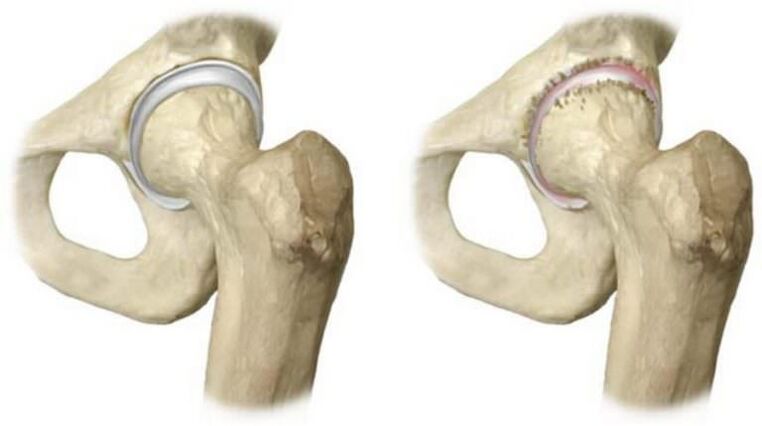
Necrosis is the death of tissue due to insufficient blood supply.In most cases, it affects the neck or head of the hip joint.This can happen for several reasons:
- compression due to injury;
- message loss due to damage;
- blood clots;
- blood clotting diseases.
The disease progresses rather quickly and affects young people more, as they are more active.
Oncology
Unfortunately, something starts to hurt because of the tumors already in the last stage.The early stages are almost symptomless.But once the pain occurs, it cannot be relieved by conventional pain relievers.Risk factors for the development of sarcoma or myeloma are trauma and prolonged inflammation.The pain may be accompanied by swelling and fever.
Fact!The pain may subside for a while and return with renewed vigor.The severity of hip pain is directly proportional to the size of the tumor.
In most cases, the pain in the right or left hip joint is caused by one of these causes, but in rare cases it can be caused by another.
Diagnostics
For hip pain, it is best to contact a general practitioner or a rheumatologist.The specialist examines and palpates the joint and selects the diagnostic method.Diagnostic methods can be:
- blood test for the presence of inflammation and infection;
- Ultrasound of the hip joint;
- tomography;
- radiography;
- osteoscintigraphy in case of suspected oncology;
- magnetic resonance examination.
After establishing the diagnosis, the doctor starts treating the hip joint pain himself or refers you to a specialist if the particular case is not within his competence.
Many specialists treat diseases that cause hip pain:
- neurologist;
- orthopedic doctor;
- allergist;
- oncologist.
If the causes are known, then the answer to the questions that arise when choosing a treatment is on the surface.

Treatment
If the hip joint hurts, different treatments may be needed and it directly depends on the diagnosis.
In case of injury, the patient must immobilize the limb and wait for further instructions from the attending physician.If a fracture or dislocation is detected, if necessary, the damaged area is reduced and fixed with a cast or a tie.After that, drugs are prescribed that promote rapid regeneration and complete rest.
In the case of symphysitis during pregnancy, it is often helpful to replace calcium and vitamin D, the reserves of which are depleted by the growing fetus.
Treatment of cancer:
- radiation therapy;
- chemotherapy;
- bone marrow transplantation.
In the case of degenerative changes of the joints, they most often start with conservative methods.
Drug treatment
The following types of drugs are used to treat coxarthrosis:
- Anti-inflammatory.To relieve inflammatory processes, in most cases, the cause of inflammation must be eliminated.But in addition, local ointments are also used.
- Hormonal anti-inflammatory.
- Chondoprotectors.It is designed to accelerate the regeneration of interarticular fluid and hyaline cartilage.
- Pain relievers.Anti-inflammatory ointments almost always contain pain relievers, but they may not help in severe pain.Stronger drugs are then prescribed.This is not done to cure the person, but to prevent him from suffering severe pain and to gain strength.
Basically, the drugs are used in combination.
Operation
In the advanced stage of coxarthrosis, when the layer between the bones is practically absent and the person can no longer walk, surgical intervention may be necessary.During this, the following manipulations are performed:
- replacement of parts of the joint or cartilage layer;
- removal of tumors;
- fusion of bones.
The following treatment methods are often used as an adjunct to medication or during rehabilitation after surgery:
- Therapeutic practice.Both the classic version and the author's class system.
- Physiotherapy.Mud baths, administration of drugs with electricity and laser.
- Massage.With its help, blood circulation improves and lymph is dispersed.But massage can cause inflammation.
All physical effects are aimed at improving blood circulation, after which healing takes place faster.But at first it may seem like your health is only getting worse.
classes

The author's exercise therapy method is becoming more and more popular.In essence, this is the same physical therapy, the exercises in which are based on the mobilization of the body's own resources on the physical and psychological level as well.
Interesting!The author of the technique is convinced that the patient must believe that his bones do not hurt, because they cannot - muscles do and can be restored by training.
All the simulators used to train with this system were developed by the author himself.
Before treating the joints with exercises, you should know that the following points are contraindications for degenerative changes in the pelvis:
- acute pain;
- oncology;
- condition before and after infarction;
- elevated temperature;
- postoperative rehabilitation;
- inflammatory processes;
- significant excess weight.
There are several other unproven techniques for treating conditions that cause hip pain:
- hirudotherapy;
- osteopathy;
- traditional methods;
- ozone therapy;
- acupuncture;
- Su-jok therapy.
It is possible that they have helped many people, but it is dangerous to rely only on such methods, as they often waste time, which is priceless in such a matter.